THE STATION
The ForCorp-owned space station takes advantage of the popular science fiction idea of using rotating centrifugal force in order to simulate Earth “gravity”. Earth gravity, inertia, and centrifugal force all create the same result, aka the healthy conditions for humans to withstand long-term space residence without negative bodily effects or future complications. This idea both has merit and gives hope to real life future space travel, but is often modified for fictional flexibility. For example NASA actually entertained ideas with centrifugal force in the 1950s after the discovery of the initial idea; particularly to make it to Mars. At one point there was also a concept that had the potential to house an entire city.
Centrifugal forces need extreme amounts of energy to work effectively, therefore the ForCorp station was built with size and mass in mind. Researchers had to balance the thin line between these two aspects of the design in order to make certain the craft could house enough fuel to get off of Earth and into space in the first place. The station doesn’t orbit Earth like all other previous space stations did (the ISS, for example). The ideal plan was for the structure to eventually drift further and further away into deep space, truly becoming untethered to Earth’s communications. Control was awarded to both the pilots and engineers on the station and the command center on Earth in order to ensure power stayed equally distributed across governments, but it was decided before the initial launch that the station had to experience substantial independence from its home planet in order to achieve the goal of eventual settlement independence.
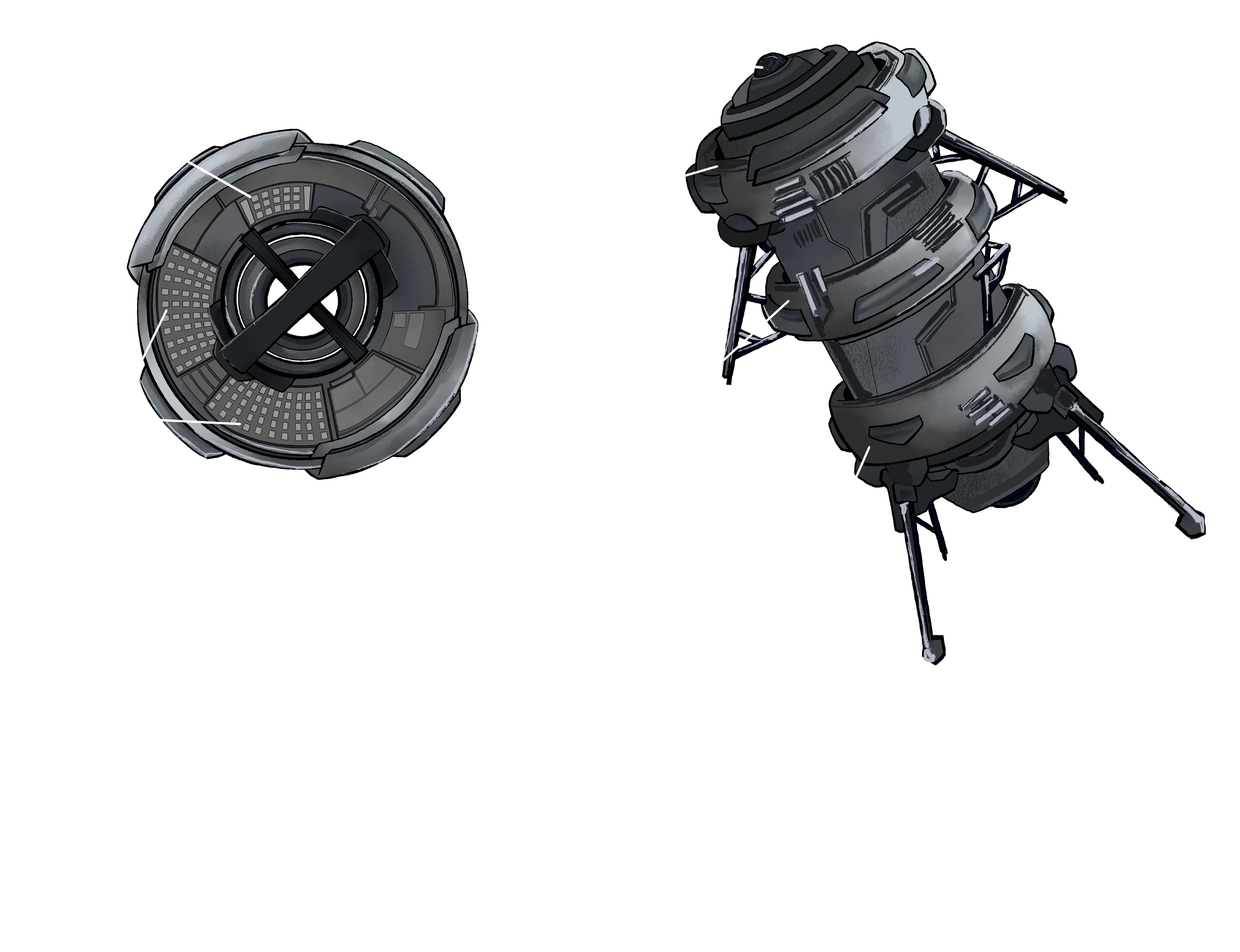
The structure consists of 3 main “rings”, each generating their very own centrifugal forces for passengers. The topmost ring is the residential ring, where almost all humans live. This includes all one hundred passengers and ForCorp staff, including mission control and the command center, which is also housed in the same ring. This space is where most time will be spent recreationally as well. The middle ring houses agriculture and industry. Human work is done here, but it tends to be shared by autonomous farming robots in order to lessen the burden. Passengers are only allowed if the correct paperwork is filed and approved, but level clearance has flexibility- unlike the bottommost ring, where almost all fuel and engine controls are located. This area becomes highly unsafe if exposed to for a long period of time, and the only work that happens down here is autonomous work done by either robots or automated systems.
HOW DO THE RINGS ATTACH?
This is where fiction takes over. Each ring is magnetically drawn to the center cylinder (or core) of the structure, held together by the rotational force. The hulls of each are extremely thick, making the possibility of leaks almost nonexistent.